Oxygen Park Doha Qatar – Green Lung of Education City | Architecture, Design & Visitor Guide
Discover Oxygen Park Doha, a sustainable urban oasis in Education City. Explore its design by AECOM, running tracks, cooling tunnels, green architecture, and visitor information.In a city renowned for its futuristic skyline and desert climate, Oxygen Park in Education City, Doha, emerges as a serene sanctuary — a place where nature, architecture, and wellness blend seamlessly. Designed by AECOM for the Qatar Foundation, this award-winning urban park is often called the “green lung” of the campus.
Spanning 130,000 square meters, Oxygen Park offers a cooling refuge in the desert with shaded walkways, looping running tracks, equestrian paths, sports pitches, and landscaped gardens. Its innovative design integrates sustainability, health, and education, providing not just recreation, but a living classroom on how design can coexist with nature in harmony.
Project Overview: A Fusion of Design and Purpose
- Location: Education City, Al Rayyan, Doha, Qatar
- Area: 130,000 m²
- Completion Year: 2019
- Client: Qatar Foundation
- Design Consultant: AECOM
- Lead Architect: Erik Behrens
- Lead Landscape Architect: James Haig Streeter
- Main Contractor: MAN Enterprise
- Engineering Partner: Arup
- Lighting Design: MBLD
- Project Management: ASTAD
The park’s vision was simple yet ambitious — to create a sustainable green space that promotes wellness, community engagement, and environmental education in the heart of the desert.
Design Inspiration: Shaped by the Desert and the Wind
The park’s architecture and topography draw direct inspiration from wind-eroded rock formations and fluid landforms of Qatar’s desert. Using computational fluid dynamics (CFD) modeling, AECOM shaped the land to maximize passive cooling from prevailing winds.
The result is a landscape that “breathes.”
- Wind passages are strategically carved between the gardens to funnel breezes through the park.
- Shaded tunnels and looping tracks provide comfort even in Qatar’s extreme heat.
- Desert-adaptive plants and softscape materials maintain natural harmony with the surrounding environment.
The buff-colored hardscape, inspired by native Qatari tones, minimizes glare and the urban heat island effect, while enhancing the park’s natural desert charm.
Park Layout: Two Distinct Zones for Recreation and Relaxation
Oxygen Park is divided into two main zones, designed to cater to both active and leisurely pursuits:
1. Western Zone – Sports and Fitness Hub
This section focuses on physical activity and outdoor recreation.
- 1.6 km looping running track with cooling tunnels
- Multipurpose sports fields for football and group activities
- Equestrian track for horseback riding
- Smart irrigation grass surfaces
2. Eastern Zone – Leisure and Educational Space
Designed for relaxation, family gatherings, and learning, this area includes:
- A children’s jungle gym and play area
- An open-air amphitheater
- Landscaped gardens and shaded seating
- Outdoor teaching and resting folly buildings
Together, these zones embody the park’s philosophy: “Exercise, Rest, and Play.”
Sustainable Landscape and Environmental Design
Oxygen Park is a model for sustainability and environmental resilience.
It showcases how design can respond intelligently to harsh climates through innovative, eco-friendly systems:
- Indigenous and desert-adaptive plants dominate the landscape — over 100 species that thrive in minimal water.
- Stormwater soakaways store rainfall underground and help replenish soil moisture.
- Smart irrigation systems use sensor technology to optimize water use.
- Cantilevering green roofs on folly buildings reduce solar heat gain and maintain cooler indoor temperatures.
By integrating water management, smart planting, and energy-efficient shading, Oxygen Park reduces resource consumption while providing a year-round green environment.
Pathways and Running Tracks: Cooling by Design
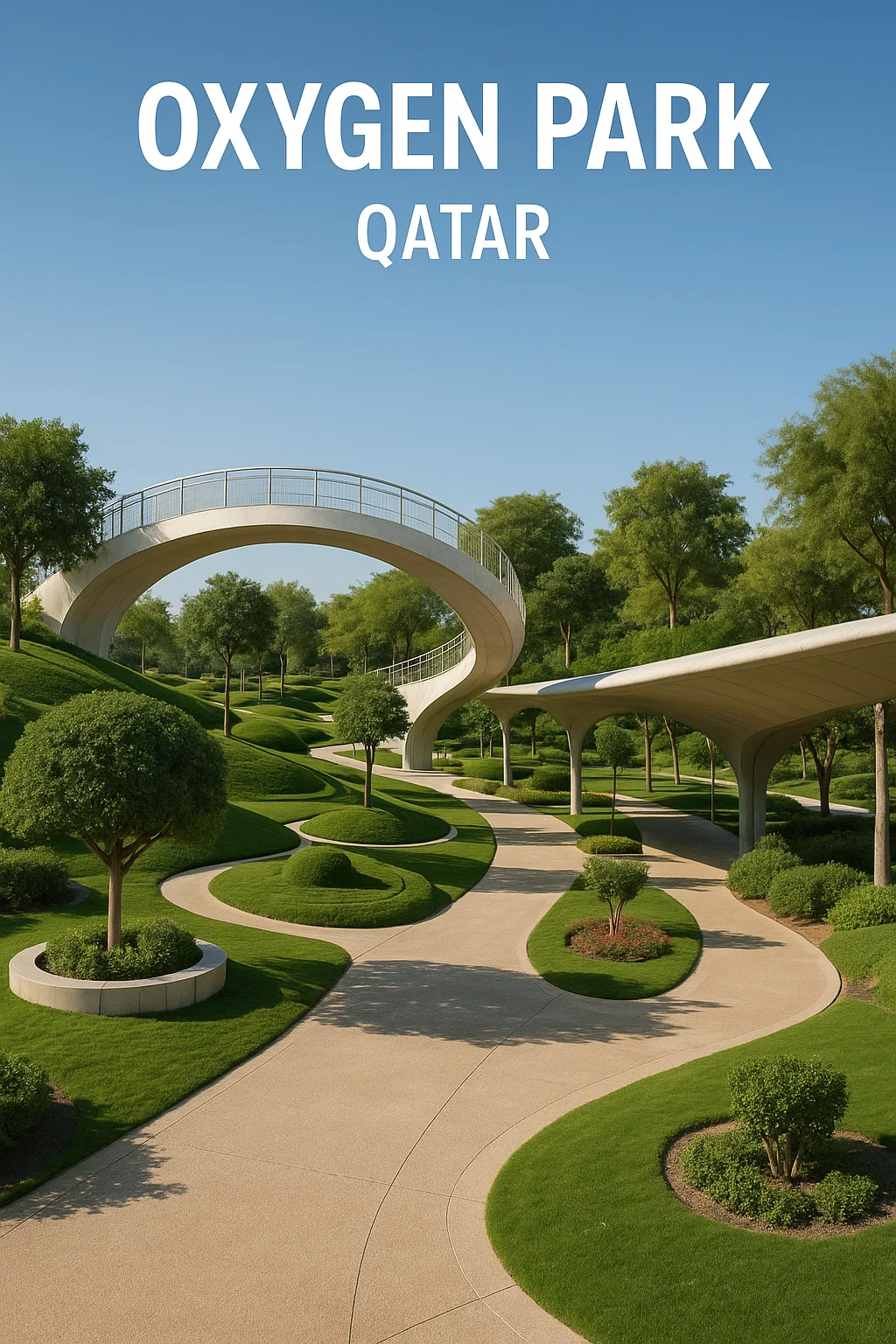
One of Oxygen Park’s most striking features is its dynamic looping running tracks and subterranean cooling tunnels.
These tunnels:
- Are embedded within the natural slopes of the park’s terrain.
- Channel cooler air using the principle of passive ventilation, similar to traditional Gulf wind towers.
- Maintain comfortable temperatures even during the day’s heat peaks.
The C-shaped reinforced concrete ribs form elegant shelters that protect runners and walkers from direct sunlight. Their monolithic stone-clad surfaces mimic desert rock, creating a sculptural experience that’s both functional and artistic.
At night, strategic lighting and illuminated pathways transform the park into a glowing landscape — perfect for evening strolls, night runs, or photography.
The Role of Plant Life: Breathing Oxygen into the City
As its name suggests, Oxygen Park emphasizes the crucial connection between plants, oxygen, and human health.
With over 100 native and adaptive plant species, the park demonstrates how vegetation can:
- Improve air quality
- Provide natural shading and cooling
- Support biodiversity in urban environments
The gardens are curated to educate visitors about Qatar’s ecological heritage, with signage that highlights plant species and their benefits.
This green diversity helps reduce carbon footprint while inspiring visitors to value sustainability in daily life.
Architectural Details: Blending Form and Function
Oxygen Park’s architectural elements are designed with precision and purpose:
● Conditioned Folly Buildings
These structures act as resting pavilions and outdoor classrooms.
- Built from reinforced concrete, embedded into hillsides.
- Covered with green roofs to absorb heat and provide insulation.
- Serve as shaded social and educational spaces for students and visitors.
● Wind-Sculpted Topography
Every hill and pathway is carefully formed to guide the flow of air.
The park’s undulating terrain not only enhances visual appeal but also promotes natural ventilation and water drainage.
● Material Palette
Buff-colored stones, seeded concrete walkways, and limestone foundations connect the park’s design to its Qatari roots while ensuring durability and minimal maintenance.
Water Management: Smart Irrigation & Stormwater Systems
Water scarcity is a critical issue in Qatar, and Oxygen Park addresses it with smart, sustainable solutions:
- Soakaways capture and store rainwater naturally.
- Sensor-based irrigation minimizes water waste by monitoring soil moisture.
- Recycled water systems are used for plant and grass maintenance.
- Permeable surfaces allow stormwater infiltration, improving groundwater levels.
This efficient water management system is a showcase of sustainability in desert landscaping.
Education and Community Engagement
Oxygen Park isn’t just a park — it’s an educational and community hub.
Located within Education City, it serves nearby institutions like Qatar University, Georgetown University Qatar, and Carnegie Mellon University Qatar, offering students an open-air classroom to learn about:
- Environmental science
- Architecture
- Sustainability
- Physical wellbeing
Workshops, fitness programs, and family-friendly events are regularly held, encouraging community connection through nature and health.
Accessibility: How to Get to Oxygen Park
Oxygen Park is easily accessible through:
- Education City Tram System
- Walking and cycling routes across the campus
- Nearby metro station: Education City Metro Station (Green Line)
For those arriving by car, parking facilities are available near the park’s main entrances.
Visiting Hours & Entry Information
- Open Daily: 5:00 AM – 9:00 PM
- Entry Fee: Free
- Best Time to Visit: Early morning or evening (for cooler weather)
The park is safe, well-lit, and perfect for families, joggers, and nature enthusiasts.
Visitor Tips
- Wear comfortable shoes — the park is large and walk-friendly.
- Bring water and sun protection during the day.
- Visit at sunset for beautiful lighting and photography.
- Explore the Education City Mosque nearby — just across from the park.
- Utilize shaded areas for rest, especially during summer months.
Awards, Recognition & Impact
Since its opening, Oxygen Park has been celebrated globally for its innovative design and environmental leadership.
It’s often cited in architecture and sustainability publications such as:
- ArchDaily
- AECOM Global Projects
- Metalocus
- Qatar Foundation Reports
Its design approach demonstrates how green infrastructure can transform urban desert environments into sustainable living ecosystems.
Broader Vision: Qatar’s Sustainable Urban Future
Oxygen Park forms part of Qatar’s larger commitment to green urbanism and environmental sustainability.
It complements national projects like:
- Msheireb Downtown Doha – the world’s first sustainable downtown regeneration project.
- Umm Al Seneem Park – one of the world’s longest air-conditioned outdoor walking tracks.
- Qur’anic Botanic Garden – showcasing plants mentioned in the Holy Quran.
Together, these initiatives represent Qatar’s dedication to building cities that balance innovation, nature, and human wellbeing.
Visual Experience: Design Highlights
- Aerial View: Demonstrates the park’s unique wind-sculpted terrain.
- Subterranean Walkways: Cooling tunnels with artistic lighting.
- Night Views: Pathways illuminated for evening activities.
- C-shaped Concrete Ribs: Architectural shelters blending form and function.
- Folly Buildings: Green-roofed pavilions for rest and learning.
All photographs are credited to Markus Elblaus, showcasing the park’s architectural elegance.
Project Team and Collaborators
- Client: Qatar Foundation
- Design Consultant: AECOM
- Lead Architects: Erik Behrens & James Haig Streeter
- Landscape Team: Mark Blackwell, Warren Osborne, Kevin Underwood, and others
- Main Contractor: MAN Enterprise
- Engineering: Arup
- Lighting: MBLD
- Project Management: ASTAD
Their collaborative effort turned an ambitious vision into a living, breathing masterpiece.
Conclusion:
Oxygen Park Doha is more than just a park — it’s a statement of Qatar’s vision for a sustainable, livable future.
It brings together art, engineering, and ecology in perfect harmony, turning the desert into a vibrant landscape where people can run, relax, learn, and breathe freely.
By creating a park that cools itself naturally, conserves water intelligently, and educates the community continuously, AECOM and the Qatar Foundation have given Doha not just green space — but a living, breathing classroom for sustainability.